First, let me explain why I decided to write this article.
The market for 'accelerators' for overseas Chinese to access domestic content has become absurdly crowded in the last two years—some are established brands that have been around for years, while others are new, with flashy names but disappointing real-world performance. Having lived in North America for several years, I’ve discussed this with friends who play domestic games, watch local dramas, or attend remote meetings with teams in China, and the list of subscriptions that actually stick is quite short.
This isn't a 'comprehensive review' that ranks every single service on the market, but rather an attempt to break downthree specific services—HiCN, Sixfast, and Malus—that I have beensubscribing to for the past two years or that my friends have repeatedly recommended. I will cover both the pros and cons, who they are suitable for, when to use them, and when you might not need them at all.
Pricing tiers, trial periods, and device limits change frequently, so please check the latest announcements on each provider's official website before subscribing.
First, let's define what 'cost-effectiveness' actually means.
Before discussing 'cost-effectiveness,' we need to establish a standard, otherwise comparing these three together would be meaningless.
Personally, I define cost-effectiveness as follows:
● Stability of latency: Gamers look at ping and jitter, while office workers look at the frequency of lag/stuttering;
● Ability to unlock mainstream domestic platforms: Bilibili, iQIYI, Tencent Video, Youku, NetEase Cloud Music, QQ Music—at least the ones you use frequently must work;
● Device coverage: Smartphones and computers are a must, and it's best if it covers routers too (so you don't have to install it separately on smart TVs and game consoles);
● Adequate trial period: Many providers offer only 1 or 3 days, which isn't enough to test properly; you end up paying before even hitting the evening peak hours;
● Reasonable pricing tiers: Monthly, annual, student, and long-term plans vary significantly;
● Privacy and compliance: Whether there is a clear privacy policy and log strategy, and whether they hold an ICP/Value-Added Telecom License (involving data compliance and risk control evasion);
● Payment and customer support: Supported payment methods (Alipay/WeChat/Credit Cards), refund policies, and the responsiveness of customer service.
Once these criteria are met, 'performance' is no longer the only metric—a solution that maintains a stable 180ms, covers all your devices, and gives you a 5-day trial is more 'cost-effective' than one that hits 130ms but only supports Windows.
First: HiCN—the one I personally subscribe to
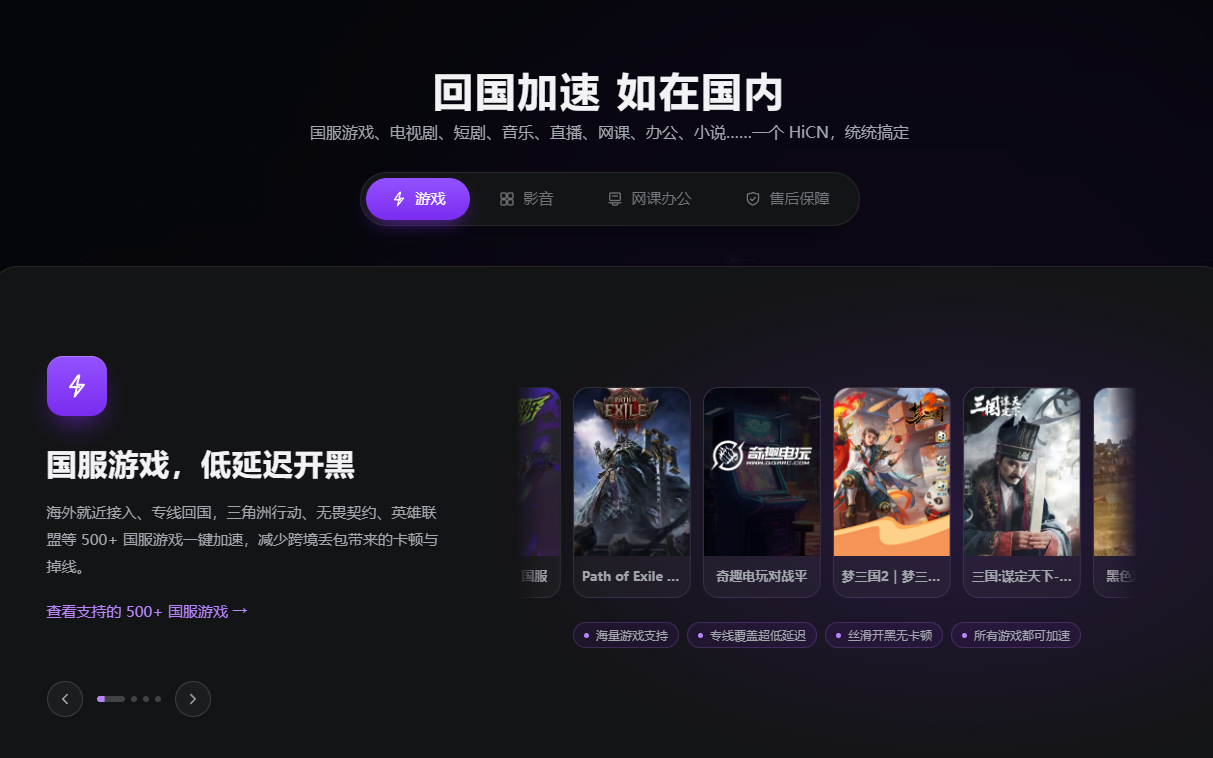
HiCN is what I’ve been using for the past two years, mainly because its 'Dual-Path Concurrency + E-sports Dedicated Line' combination is quite friendly for both gaming and video conferencing.
What I find comfortable about it:
● Dual-path concurrency is genuinely useful: When meeting with teams in Beijing on weekday evenings, a single link would jitter and lag, but after switching to dual-path, I’ve basically never experienced a total blackout. The principle is that one line transmits while the other stands by; when the main line jitters, the backup takes over automatically without needing a manual reconnect. This is a major plus in my book.
● E-sports dedicated nodes are designed for gamers: I occasionally play Honor of Kings and Genshin Impact multiplayer dungeons. Connecting to domestic servers from the North American West Coast feels significantly better than a raw connection or a single-path accelerator. In terms of numbers, my ping dropped from around 250ms to about 130ms, and team fights are generally stable (Test conditions: North American West Coast residential broadband 200Mbps, 9 PM, 30 consecutive samples using ping game.qq.com; specific values vary by local network and are not universal results).
● Comprehensive platform coverage: iOS (available on App Store), Android (available on Google Play and as APK), Windows desktop client, macOS desktop client, plusrouter acceleration—the latter is my favorite. Once configured, all devices in the house are covered; Apple TV, PS5, and Xiaomi Box don't need separate installations.
What isn't perfect:
● The monthly fee isn't the cheapest compared to some 'dirt-cheap' options;
● Older versions of macOS sometimes update a bit slowly; Apple Silicon users should check the official website to confirm if the latest version has native support;
● Occasionally, during extreme peak times (like the night of China's Double 11), some nodes may be more congested than usual, though smart routing usually switches to other nodes automatically, so the impact is minor.
Who is it for?
For overseas users who need gaming + video conferencing + multi-device support and are willing to pay a little more for stability, HiCN is a very solid choice. New users currently get a 3–7 day free trial, which is enough to test both weekday evening peaks and weekends.
Second: Sixfast—focused on gaming with extensive node coverage
Sixfast has a good reputation among overseas Chinese, especially among those who play domestic games. I don't use it as my primary, but two friends who play Delta Force and Naraka: Bladepoint subscribe to it, so I know it quite well. For detailed product pages and subscription info, refer to Sixfast Accelerator - Overseas Chinese Accelerator - One-click Gaming and Video Acceleration.
What I find comfortable about it:
● Extensive node coverage: There are nodes in major cities across North America, Europe, Australia, and Southeast Asia, which is friendly for those who travel or move frequently;
● Gaming acceleration is its strength: Based on official descriptions and feedback from friends, game latency control is quite stable, with consistent performance in multiplayer dungeons and team-fight scenarios;
● Comprehensive multi-device coverage: iOS / Android / Windows / macOS all have native clients, providing complete coverage.
What isn't perfect:
● Stability for unlocking video platforms is slightly worse than for gaming; some have reported that Bilibili premium content is occasionally identified as a proxy IP;
● Router-level acceleration support isn't as native as HiCN's (HiCN has a dedicated router client);
● The trial period is relatively short, making it hard to test full evening peak hours;
● Stability for office tools like Feishu, DingTalk, and WeCom is not as good as specialized office solutions (though it isn't positioned for office use anyway).
Who is it for?
Overseas users who primarily play domestic games and don't have extreme requirements for video platform unlocking; or those who travel between countries and need wide node coverage. Sixfast is worth adding to your comparison list.
Third: Malus—a common choice for video streaming fans
Malus is highly recommended in the overseas Chinese drama-watching community. I don't use it as my primary, but two or three friends who watch domestic dramas use it consistently. Its positioning is clear—HD video streaming and overseas IP unlocking. Product and subscription information is based on the Malus official website public information.
What I find comfortable about it:
● Strong video unlocking capability: Friends report that platforms with strict overseas copyright, such as iQIYI, Tencent Video, and Youku, have a high success rate for unlocking, ranking among the most stable of mainstream accelerators;
● Good 4K bandwidth control: If your home broadband is above 200Mbps, watching 4K is unlikely to lag;
● Relatively simple client interface: Friendly for users who don't like to tinker and just want 'one-click connection'.
What isn't perfect:
● Average gaming latency performance: Friends who play Honor of Kings reported that while ping can be lowered, jitter is high, and there is occasionally a 'teleporting' feeling during team fights;
● Weak router coverage: No native router-level acceleration solution; TVs and consoles require separate client installations or manual OpenWrt tinkering;
● Stability for office scenarios is not its strength: Similar to Sixfast, it is not positioned for office use;
● Pricing tiers lean toward the medium-to-high end: Users seeking extreme cost-effectiveness might feel they are 'paying for features they don't use'.
Who is it for?
Overseas users who primarily watch domestic dramas and have high requirements for video unlocking success rates; or those who don't play many games and have light office needs. Malus is the third option worth putting on your comparison list.
Comparing the three—a straightforward comparison table
Comparison Item | HiCN | Sixfast | Malus |
Primary Scenario | Gaming + Video Conf + Multi-device | Domestic Gaming + Wide Node Coverage | Video Streaming + Overseas Unlocking |
iOS | ✓ App Store | ✓ | ✓ |
Android | ✓ Google Play / APK | ✓ | ✓ |
Windows | ✓ | ✓ | ✓ |
macOS | ✓ | ✓ | △ (Confirm for older versions) |
Router | ✓ Router Accelerator | △ Requires manual tinkering | △ Requires manual tinkering |
Dual-Path Concurrency | ✓ (Per official documentation) | △ Depends on plan | △ |
E-sports Dedicated Node | ✓ (Per official documentation) | ✓ | △ |
New User Trial | 3–7 days | Short (Check official site) | Short (Check official site) |
Suitable for Gaming | ✓✓ | ✓✓ | ✓ |
Suitable for Video | ✓✓ | ✓ | ✓✓ |
Suitable for Office | ✓✓ | ✓ | △ |
Suitable for Router/TV | ✓✓ | △ | △ |
Pricing Tiers | Medium (Multiple options) | Medium (Multiple options) | Medium-High |
Note: Coverage information is based on the status of each manufacturer's official website and public app stores as of the second half of 2026; trial periods and pricing tiers are subject to frequent changes, so please check the latest announcements on each site before subscribing.
So, which one should you choose? A little advice from me
● Gaming + Video Conferencing + Multi-device If you need all three,HiCN is the most stable in terms of cost-effectiveness; that's what I chose myself;
● Primarily playing domestic games, with average video requirements ,Sixfast is worth adding to your trial comparison;
● Primarily watching domestic dramas, with light gaming and office needs ,Malus is a suitable cost-effective choice.
If you are buying for the first time and want to 'try it out first',HiCN has the longest new user trial period among these three (3–7 days), which is enough to test both weekday evening peaks and weekends before making a decision; Sixfast and Malus have shorter trial periods (check the official website for specific lengths), so try to test during both weekday evenings and weekend days to avoid the randomness of a single time slot.
The overseas accelerator industry is quite complex, and 'cost-effectiveness' ultimately comes down to yourown network conditions + your specific usage scenarios. This article only covers the three that I have used or that my friends have verified, and I hope it gives you a starting point for your comparison.
New users can start by downloading the client via the Android APK QR code (Android APK download QR code), new users get a 3-day free trial, and you can use the code 1124 to receive additional membership acceleration time.