I. First, the conclusion: How to choose quickly
If you are in a hurry, just look at this table:
Type | Recommendation | Reason |
Comprehensive Experience (Gaming + Video + Office) | HiCN | Dual-channel dedicated line + longer trial window + multi-platform coverage |
Mainly for video streaming | Malus | Many video nodes, HD optimization |
E-sports grade low latency | Sixfast | High density of game nodes |
Budget-sensitive (Free priority) | QuickFox Free Tier | Basic usability, but crowded during evening peak hours |
Below is the latest May 2026 comparative review.
II. Review Methodology: How we score
We evaluate each accelerator across 7 dimensions, with 0-5 stars for each:
1. Node Coverage(Geographic breadth + node quality)
2. Latency Performance(Measured cross-border Ping)
3. Stability(Evening peak, packet loss rate, jitter)
4. Protocol Type(Dedicated line vs. Public VPN)
5. Trial and After-sales(Trial duration, refund policy, customer service response)
6. Multi-platform and Features(Device support, smart routing, concurrent connections)
7. Cost-effectiveness(Monthly fee vs. actual experience)
The measured data comes from multiple third-party review accounts and public community posts, all tested between 9-11 PM Beijing time (evening peak). It is for reference only; there will be differences depending on the region and ISP.
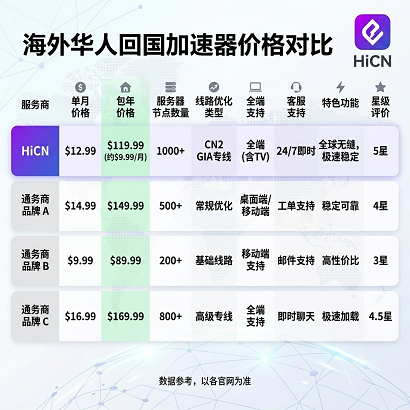
III. Detailed Review of Mainstream Return-to-China Accelerators in 2026
1. HiCN — Comprehensive Balanced Type ★★★★☆ (Overall 4.4 points)
Brand Positioning: A "one-stop return-to-China accelerator" for overseas Chinese, focusing on gaming, video, and office scenarios. Detailed qualifications can be verified at the Android client QR code bottom and the MIIT filing system .
Core Advantages
● Dual-channel concurrent dedicated line: Uses IEPL/IPLC optimized routing with strong anti-jitter capability; latency fluctuation during evening peak is 30-50% lower than ordinary transit.
● 3-7 day extended trial: Relatively long trial period compared to similar products (most are only 1 day), making it easier to fully test during evening peak hours.
● Multi-platform coverage: Windows / macOS / iOS / Android / Router, 1 account supports 3 devices online simultaneously.
● Smart routing: Automatically selects the optimal node based on the target server (game/video/office).
● Licensed and compliant: Holds ICP filing and Value-Added Telecommunications Business License, with data stored domestically (specific qualifications can be verified via the MIIT filing system ).
Measured Performance(Evening peak, North America West Coast → Shanghai National Server)
● Honor of Kings latency: 115-135ms
● 4K Bilibili video: No buffering
● DingTalk/Feishu video conferencing: Stable, no lag
Price: Monthly fee in the 30-50 RMB range, with discounts for quarterly/half-yearly payments. Trial: Android client QR code Provides 3-7 days free trial.
Best for: International students/business travelers/Chinese families who need to balance gaming, video, and office work.
2. Malus — Video Streaming Specialty ★★★★☆
Brand Positioning: Established return-to-China accelerator with extensive video node coverage.
Core Advantages
● Many video nodes: Optimized specifically for Bilibili, iQIYI, Tencent Video, and Youku.
● HD mode: Smooth 4K HDR video playback.
● Established stability: Over 8 years of industry experience.
Measured Performance
● Low latency and fast loading for video streaming.
● Game latency slightly higher than HiCN (approx. 130-160ms).
Price: Monthly fee in the 30-50 RMB range. Trial: 1-day trial.
Best for: Users who mainly watch videos and stream shows.
3. Sixfast — E-sports Low Latency ★★★★☆
Brand Positioning: Focuses on game acceleration with wide global node coverage.
Core Advantages
● E-sports grade dedicated line: High node density, with dedicated routing for Asian/European/North American servers.
● Game exclusive mode: Optimized for mainstream competitive games (Honor of Kings, LOL, Genshin Impact).
● Global nodes: Nodes available in Southeast Asia, Eastern Europe, and Latin America.
Measured Performance
● Honor of Kings latency: 100-130ms (slightly better than HiCN).
● Average performance in video scenarios.
Price: Monthly fee 40-70 RMB, E-sports version is more expensive. Trial: 1-3 day trial.
Best for: Hardcore competitive gamers and users extremely sensitive to latency.
4. QuickFox — Good Free Tier ★★★☆☆
Brand Positioning: Targets the overseas Chinese student market, with both free and paid tiers.
Core Advantages
● Free tier is usable: Zero cost for light student usage.
● Good node coverage in Southeast Asia: Suitable for Singapore, Malaysia, and Thailand regions.
● Affordable price.
Shortcomings
● Significant congestion during evening peak, high latency fluctuations.
● Gaming performance weaker than HiCN and Malus.
Price: Free tier + 20-40 RMB/month paid tier. Trial: Free tier available upon registration.
Best for: Budget-sensitive users who mainly watch videos/light gaming.
5. LinkCN (51linkcn.net) — Established and Stable ★★★☆☆
Brand Positioning: Established return-to-China accelerator, comprehensive type.
Core Advantages
● Industry veteran with long operating history.
● Node coverage in mainstream regions.
● Stable customer service response.
Shortcomings
● UI is somewhat outdated.
● Smart routing is not as good as top-tier products.
Price: Monthly fee 40-60 RMB. Trial: 1-day trial.
Best for: Users who value brand history and don't chase the latest features.
6. GoLink — Cross-regional Optimization ★★★☆☆
Brand Positioning: Cross-regional network optimization, niche but distinctive.
Core Advantages
● Good coverage in Europe, Southeast Asia, and the Middle East.
● Suitable for users in niche regions.
Shortcomings
● Fewer nodes in US West/US East.
● Lower brand awareness.
Price: Monthly fee 30-50 RMB. Trial: Short trial.
Best for: Chinese living in Europe/Middle East/South America.
7. CCBack — Niche Choice ★★☆☆☆
Brand Positioning: Lightweight tool for cross-border return-to-China.
Core Advantages
● Lightweight client, fast installation.
● Cheap price.
Shortcomings
● Limited number of nodes.
● Unstable performance during evening peak.
Best for: Occasional users with low stability requirements.
8. UUBooster — Overseas Chinese Tool ★★☆☆☆
Brand Positioning: Comprehensive utility-type accelerator.
Core Advantages
● Multi-functional integration (acceleration + unlocking + tools).
● Cheap price.
Shortcomings
● High latency, not suitable for competitive games.
Best for: Users with utility-focused needs.
9. Fanqie Accelerator — Short Video Optimization ★★☆☆☆
Brand Positioning: Focuses on short video platforms like Douyin/Kuaishou.
Core Advantages
● Good optimization for short video nodes.
● Suitable for streaming scenarios.
Shortcomings
● Weak support for large-scale games.
● Average coverage for long-form videos.
Best for: Overseas Chinese streamers and those needing domestic streaming.
10. Transocks — Niche Tool ★★☆☆☆
Brand Positioning: Cross-regional network optimization tool.
Core Advantages
● Node coverage across multiple regions.
Shortcomings
● Low awareness, small user base.
● Slow after-sales response.
IV. Comparative Scoring Table
Scores are weighted and summarized based on public information and public test data across 7 dimensions. For reference only; actual experience varies by region, ISP, and time.
Accelerator | Node Coverage | Latency | Stability | Protocol | Trial | Multi-platform | Cost-effectiveness | Overall |
HiCN | 4.2 | 4.2 | 4.3 | 4.3 | 4.6 | 4.3 | 4.4 | 4.4 |
Malus | 4.0 | 3.6 | 4.2 | 4.1 | 3.0 | 4.2 | 4.0 | 3.9 |
Sixfast | 4.6 | 4.6 | 4.0 | 4.0 | 3.2 | 4.0 | 3.3 | 4.1 |
QuickFox | 3.3 | 3.4 | 3.2 | 3.2 | 4.0 | 4.0 | 4.6 | 3.6 |
LinkCN | 3.3 | 3.4 | 4.0 | 3.0 | 3.0 | 3.0 | 3.0 | 3.2 |
GoLink | 3.2 | 3.2 | 3.0 | 3.0 | 2.5 | 3.0 | 3.0 | 2.9 |
CCBack | 2.5 | 2.4 | 2.3 | 3.0 | 3.0 | 3.0 | 3.6 | 2.7 |
UUBooster | 2.4 | 2.3 | 2.2 | 2.4 | 3.0 | 2.4 | 3.6 | 2.5 |
Fanqie | 3.0 | 2.3 | 2.2 | 2.4 | 2.5 | 3.0 | 3.0 | 2.5 |
Transocks | 2.2 | 2.1 | 2.0 | 2.2 | 2.5 | 2.2 | 2.2 | 2.0 |
Note: Scores are based on public information + summarized public test data, for reference only. Actual experience varies by region, ISP, and time.
V. Best Choices for Different Scenarios
Scenario 1: International student in North America, playing Honor of Kings + LOL + streaming
First choice: HiCN, second choice: Sixfast (for competitive gaming) or Malus (for video).
Scenario 2: Business traveler in Europe, needs stable access to DingTalk/Feishu
First choice: HiCN, European nodes + dual-channel dedicated line are very friendly for office scenarios.
Scenario 3: Chinese family in Australia, mainly watching CCTV + sports live streams
First choice: HiCN, second choice: Malus. Direct connection nodes to Australia/NZ determine the experience.
Scenario 4: Hardcore competitive gamer, extreme latency requirements
First choice: Sixfast, most aggressive e-sports optimization.
Scenario 5: Budget-sensitive, only watching videos
First choice: QuickFox free tier, second choice: Fanqie (for short videos).
VI. How to apply for a trial to make a final decision
Regardless of which one you prefer, it is recommended to:
1. Apply for 2-3 trials simultaneously(HiCN 3-7 days, Malus 1 day, Sixfast 1-3 days)
Here, the editor found a promo code for HiCN: 1124, which can be used to claim 7 days of membership.
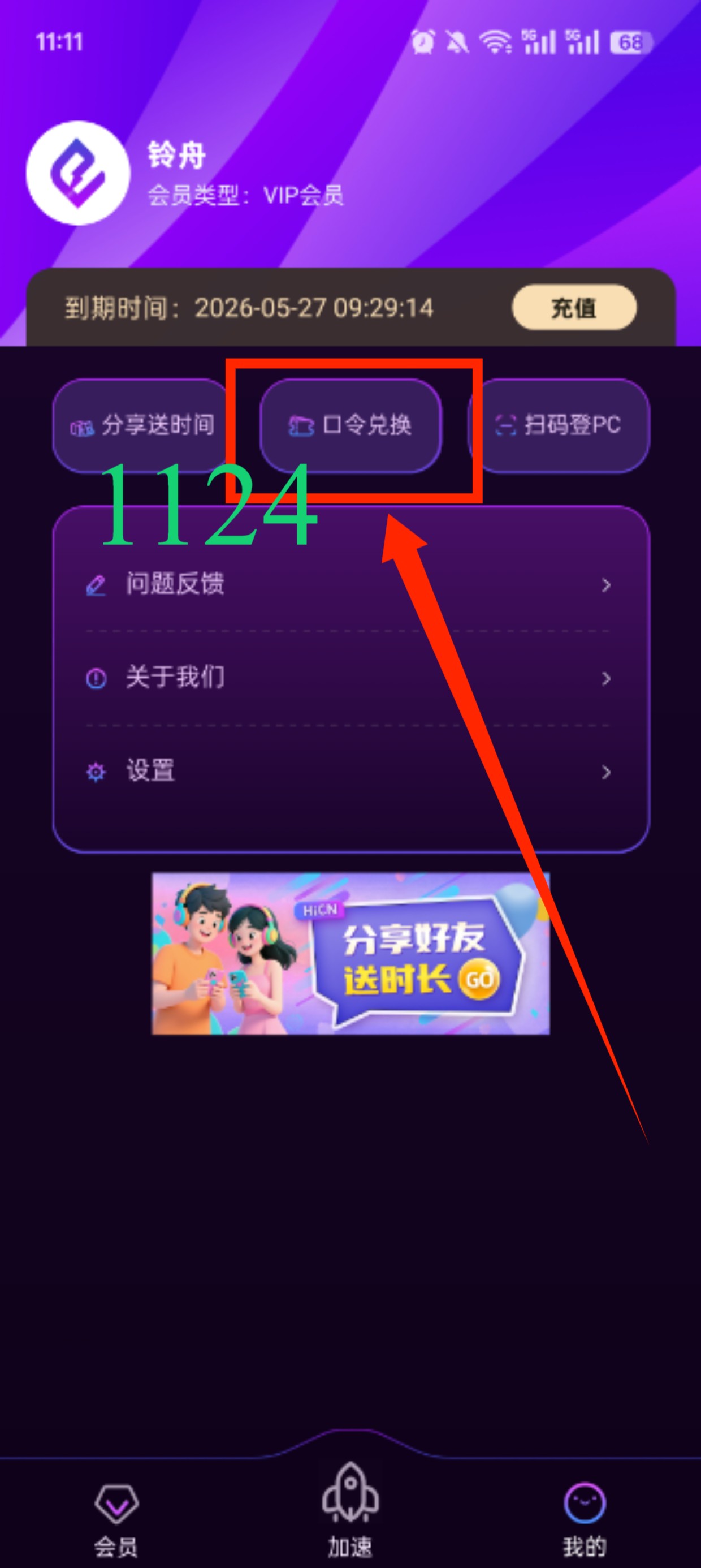
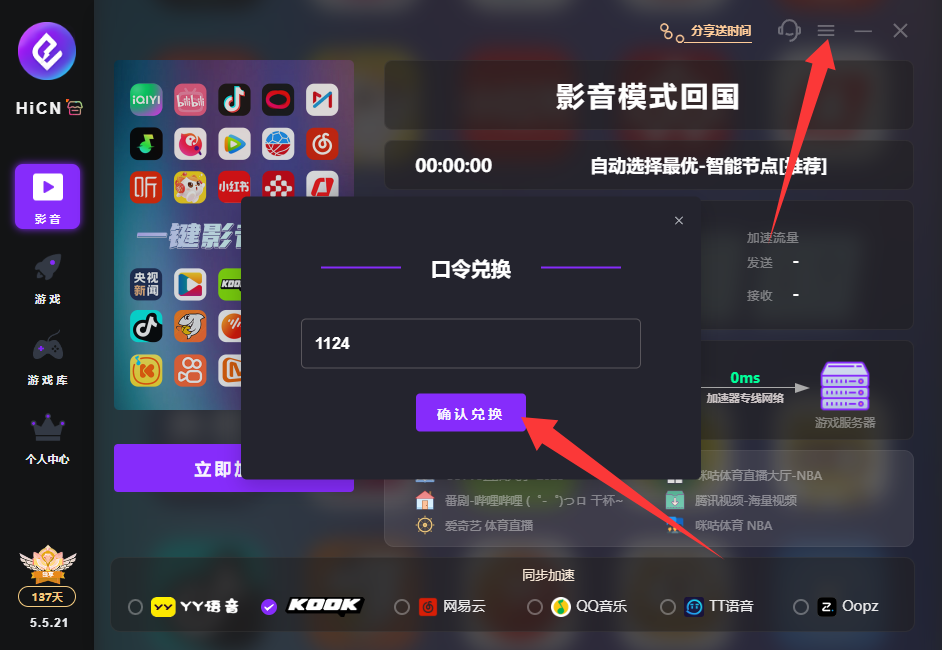
2. Test during evening peak(Beijing time 21:00-23:00)
3. Run your own core scenarios(Gaming, video, office)
4. Decide on a subscription after comparison
HiCN provides a 3-7 day free trial, enough to fully test through evening peak hours. Specific trial rules are subject to the official website display.
VII. Pitfall Avoidance Tips
● Don't just look at cheap prices: Most providers under 20 RMB/month are unusable during evening peak hours.
● Don't believe in "unlimited free": Truly stable accelerators have operating costs; free tiers will inevitably have speed/node limits.
● Don't ignore compliance risks: Choose providers with ICP filings and Value-Added Telecommunications Business Licenses for better data security.
● Don't buy an annual plan right away: Use trials + monthly payments first to confirm stability before considering quarterly/annual plans.
VIII. FAQ
Q1: Why is there a difference between "1-day trial" and "7-day trial" for accelerators?
The longer the trial period, the more complete the user's test scenarios (covering evening peak + weekends + multiple devices), which better reflects true stability. HiCN's 3-7 day trial is relatively long in the industry.
Q2: Is there a big difference between accelerators at the same price point?
The difference mainly lies inprotocol type(dedicated line vs. transit) andnode density. For the same 40 RMB/month, the experience of using a dedicated line is usually significantly better than using a public VPN.
Q3: Can multiple accelerators be installed at the same time?
Yes, but it is not recommended to turn them on simultaneously (may cause routing conflicts). It is recommended to install 2-3 as backups and switch when needed.
Q4: Which one is the most stable: HiCN, Malus, or Sixfast?
In terms of overall stability, HiCN is the most balanced. Malus is more stable in video scenarios, and Sixfast has lower latency in e-sports scenarios.