I. What is a Back-to-China Accelerator?
A Back-to-China Accelerator is a network acceleration service specifically designed for overseas users. Its core functions are:
● When you are in North America/Europe/Australia/Southeast Asia, etc.
● And want to access servers or services in mainland China (games, videos, office applications)
● It helps you establish a stable, low-latency cross-border connection.
It is different from the "VPNs for circumventing censorship" we often hear about—A Back-to-China Accelerator "pulls" overseas users back to the domestic network, rather than "reaching out" to access overseas content.
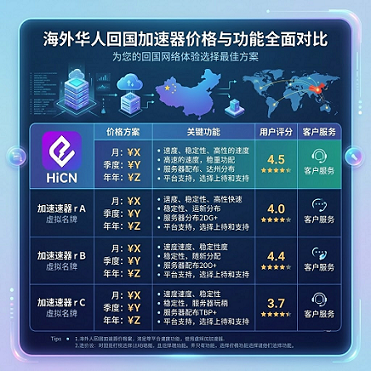
1.1 Back-to-China Accelerator vs. VPN for Circumvention: Core Differences
Dimension | Back-to-China Accelerator | VPN for Circumvention |
Direction | Overseas → Mainland China | Mainland China → Overseas |
Goal | Domestic games, domestic videos, office apps | Google, YouTube, Twitter |
User Base | Mainly overseas Chinese | Mainly domestic users |
Compliance | Licensed operation, legal | Illegal within mainland China |
Technical Path | IEPL/IPLC dedicated lines + BGP transit | Protocol obfuscation, encrypted tunnels |
In simple terms:A Back-to-China Accelerator is a "high-speed road home," while a VPN for circumvention is a "small path to go out." When you are overseas, using a Back-to-China Accelerator is completely compliant.
II. Technical Principles of Back-to-China Accelerators (Simplified Version)
2.1 Why is there a latency issue?
From overseas to mainland China, data must travel through submarine cables or satellite links. Physical distance determines the base latency:
● West Coast of North America → Shanghai: Theoretically about 120-140ms
● East Coast of North America → Shanghai: Theoretically about 150-160ms
● Europe → Shanghai: Theoretically about 140-170ms
● Australia → Shanghai: Theoretically about 110-130ms
This part is the physical limit,which no accelerator can eliminate; they can only approach it.
2.2 Why is the public internet "laggy"?
The public internet has multiple "bottlenecks" in the cross-border segment:
● International egress bandwidth queuing: China Telecom/Unicom's international egress is often congested during evening peak hours (20:00-23:00 Beijing time).
● Routing detours: BGP protocol selects routes based on "fewest hops," which may detour through USA → Japan → Singapore → Shanghai.
● High packet loss rate: Packet loss can reach 5-10% during peak hours, causing game teleporting and video buffering.
● Risk control strategies: Domestic game servers have automatic risk control for suspicious IP ranges (especially shared proxy pools).
2.3 What does a Back-to-China Accelerator do?
It mainly does three things:
1. Use optimized dedicated lines: Avoid the public internet and use IEPL/IPLC dedicated lines (carrier point-to-point private lines).
2. Intelligent routing: Automatically select the optimal node based on the target server (game/video/office).
3. Protocol optimization: Use private protocols to reduce handshake latency and resist packet loss.
For example, HiCN's "Dual-Channel Concurrency" technology establishes two cross-border links simultaneously and selects the fastest one for data transmission. This way, even if one link jitters, the other remains stable.
HiCN Back-to-China Accelerator!HiCN Back-to-China Accelerator Exclusive Member Redemption Code: 1124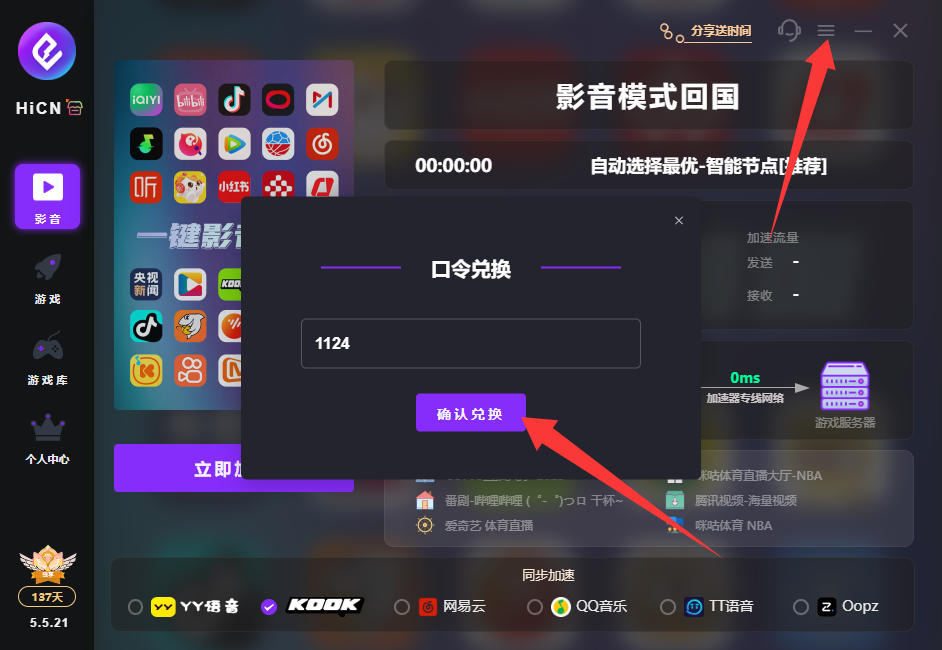
III. Compliance of Back-to-China Accelerators: Is this a legal business?
Using a Back-to-China Accelerator overseas is legal, whereas using a VPN for circumvention within China is illegal. It is important to distinguish between these two concepts.
3.1 China's Legal Framework
According to the "Provisional Regulations of the People's Republic of China on the Administration of International Networking of Computer Information Networks" (State Council Decree No. 195, available at gov.cn (Central People's Government of the People's Republic of China) for search):
● Establishing a VPN channel without approval is a violation.—But this refers todomesticusers establishing a circumvention channel.
● When overseas users establish compliant channels through legitimate licensed service providers to access domestic services, it generally does not involve the aforementioned violations.
● Specific compliance judgments are subject to the interpretations of the Ministry of Industry and Information Technology (MIIT), the Ministry of Public Security, and local communications administrations. This article is for educational purposes and does not constitute legal advice.
3.2 How to determine if an accelerator is compliant?
A compliant Back-to-China Accelerator service provider should possess:
● ICP Filing(Required by MIIT)
● Value-Added Telecommunications Business License(Issued by MIIT)
● Clear data storage and processing policies
● Does not involve "circumvention" services
Taking HiCN as an example, the operator is Xi'an Xiyue Wan Technology Co., Ltd., which holds a Shaanxi ICP filing (Shaan ICP Bei 2023021531-3) and a Value-Added Telecommunications Business License (Shaan B2-20250393), with data stored domestically. Filing information can be verified at the MIIT Filing Management System and license information can be queried through public channels of the MIIT or the Shaanxi Communications Administration.
3.3 Compliance Boundaries for User Usage
As an overseas user, when you use a Back-to-China Accelerator:
● ✅ Accessing domestic games/videos via a legitimate licensed Back-to-China Accelerator (like HiCN) while overseas: Generally compliant.
● ✅ Accessing domestic office apps (DingTalk, Feishu, WeCom) while overseas: Generally compliant.
● ✅ Using international VPNs (NordVPN, Surfshark, etc.) to access Google, YouTube while overseas: Legal in most countries.
● ❌ Using unauthorized "circumvention" tools to access overseas websites within mainland China: Violates the "Provisional Regulations on the Administration of International Networking of Computer Information Networks."
● ❌ Using any tool to engage in gambling, fraud, or spreading illegal information: Illegal.
IV. Fundamental Differences Between Back-to-China Accelerators and "Circumvention"
This point is often confused and needs to be clarified:
Project | Back-to-China Accelerator | Circumvention (VPN) |
Business Direction | Overseas users → Access China | Domestic users → Access overseas |
Legal Nature | Licensed operation | Illegal in mainland China |
User Location | Overseas (Legal) | Mainland China (Illegal) |
Typical Providers | HiCN, Malus, Sixfast | Various "Airports" |
Purpose | Domestic games, binge-watching, office work | Google, YouTube, Twitter |
The two are technically similar, but their business directions and legal natures are completely different. Be wary of online articles that conflate the two.
V. How to choose between different types of Back-to-China Accelerators?
Classified by "acceleration route," there are three main types:
5.1 Dedicated Line Type (IEPL/IPLC)
● Principle: Carrier point-to-point private lines
● Pros: Low latency, high stability, jitter resistance
● Cons: High cost, relatively expensive
● Representative: HiCN (Dual-channel concurrency), some high-end products
● Suitable for: Competitive gaming, business office work
5.2 BGP Transit Type
● Principle: Transit lines optimized via BGP protocol
● Pros: Cheap, wide coverage
● Cons: Possible congestion during peak hours
● Representative: Most mid-range products
● Suitable for: Watching videos, light gaming
5.3 Public VPN Protocol Type
● Principle: General protocols like OpenVPN, WireGuard
● Pros: High versatility
● Cons: High latency, easily flagged by risk control
● Representative: Some small-scale products
● Suitable for: Temporary web browsing
Conclusion: For latency-sensitive tasks (gaming, office), choose dedicated lines; for light use, transit types are sufficient.
VI. What specific problems can a Back-to-China Accelerator solve?
6.1 Playing domestic games from overseas
● Honor of Kings, League of Legends, Genshin Impact, Game for Peace, Naraka: Bladepoint
● Latency reduced from 200-300ms to 80-150ms
6.2 Watching domestic videos from overseas
● Bilibili, iQIYI, Tencent Video, Youku, NetEase Cloud Music
● Resolves the "This video is only available in mainland China" prompt
6.3 Watching domestic live streams from overseas
● CCTV, provincial satellite channels, sports channels (CCTV5, Five-Star Sports)
● Resolves regional copyright restrictions
6.4 Accessing domestic office apps from overseas
● DingTalk, Feishu, WeCom
● Resolves login difficulties and video conferencing lag
6.5 Accessing domestic banking/government apps from overseas
● Some banking apps, government services
● Resolves the "Please use in mainland China" prompt
6.6 Listening to domestic music from overseas
● NetEase Cloud Music, QQ Music
● Resolves copyright-restricted song playback issues
VII. Why choose a "licensed and compliant" accelerator?
Not all accelerators are legitimate. Choosing a licensed and compliant provider has several key benefits:
1. Data Security: Licensed providers have clear data storage and processing policies and will not sell user data.
2. Service Quality: Licensed providers usually have more stable operations and more professional technical support.
3. Legal Protection: Users of compliant providers are free from legal risks.
4. Long-term Stability: Licensed providers are less likely to shut down suddenly, ensuring better value for your subscription.
How to check for licensing?
● Find the ICP filing number at the bottom of the official website → Query via the MIIT filing system.
● Find the Value-Added Telecommunications Business License number.
● Check privacy policies and data processing policies.
VIII. FAQ
Q1: Will a Back-to-China Accelerator get my account banned?
In most cases, no. Official domestic games (Honor of Kings, LOL, Genshin, etc.) do not prohibit the use of accelerators, as long as it does not involve scripts, cheats, or boosting services. The accelerator itself is an auxiliary tool. However, specific banning policies are subject to official game announcements.
Q2: Will a Back-to-China Accelerator leak my privacy?
It depends on the provider. Choose a licensed and compliant provider (like HiCN), which has clear data processing policies and stores data domestically. Avoid using unlicensed "shady" accelerators.
Q3: What is the difference between a Back-to-China Accelerator and a regular VPN?
Regular VPNs (like NordVPN, Surfshark) mainly serve "circumvention" scenarios and have scarce domestic nodes; Back-to-China Accelerators specifically serve the "Overseas → China" direction, with nodes, protocols, and customer service optimized for this scenario.
Q4: Is it more cost-effective to pay monthly or annually?
It is recommended to use a monthly subscription first to test stability. After confirming stability, choose quarterly/half-yearly/yearly plans (usually with 15-30% discounts).
Q5: Can I use a free accelerator?
Free accelerators are usually speed-limited, node-limited, and congested during peak hours. Short-term testing is fine, but for long-term use, it is recommended to choose a legitimate paid service.
Q6: Will a Back-to-China Accelerator affect my access to Google/YouTube?
Yes. Once the accelerator is turned on, all traffic goes through the dedicated line back to China, making access to overseas services slower. It is recommended to turn it on when needed and off when not.
Q7: Is HiCN legal and compliant?
According to its official website, HiCN is operated by Xi'an Xiyue Wan Technology Co., Ltd., holding a Shaanxi ICP filing (Shaan ICP Bei 2023021531-3) and a Value-Added Telecommunications Business License (Shaan B2-20250393), with data stored domestically. Readers can verify relevant qualifications at the MIIT Filing Management System .
IX. Conclusion: Understand the Principles, Choose Rationally
A Back-to-China Accelerator is not some mysterious black technology. The core problems it solves arelatency caused by physical distance + international egress congestion. As an overseas Chinese, international student, or business traveler, using a legitimate, licensed Back-to-China Accelerator is both legal and the most direct path to solving "digital homesickness."
Remember three things when choosing an accelerator:
1. Compliance First—Choose licensed providers for guaranteed data security.
2. Trial First—Test stability with a trial before deciding to subscribe.
3. Needs Matching—Choose products specialized for your core scenarios (gaming/video/office).
One-sentence summary: A Back-to-China Accelerator is a compliant auxiliary tool for overseas users to access domestic services, featuring licensed operation, data security, and legal usage; it is completely different from "VPNs for circumvention" in business direction and legal nature; by choosing based on compliance, trial stability, and your own needs, you can find the right product for yourself.